
When To Use CBO vs. ABO in Meta Ads?
What kind of budget optimization are you using for your ads? Are you using Campaign Budget Optimization (CBO) for omnibus branded ads? Or are you managing your budgets more intently with Ad Set Budget Optimization (ABO)? Do you know when to use CBO vs. ABO in Meta ads?
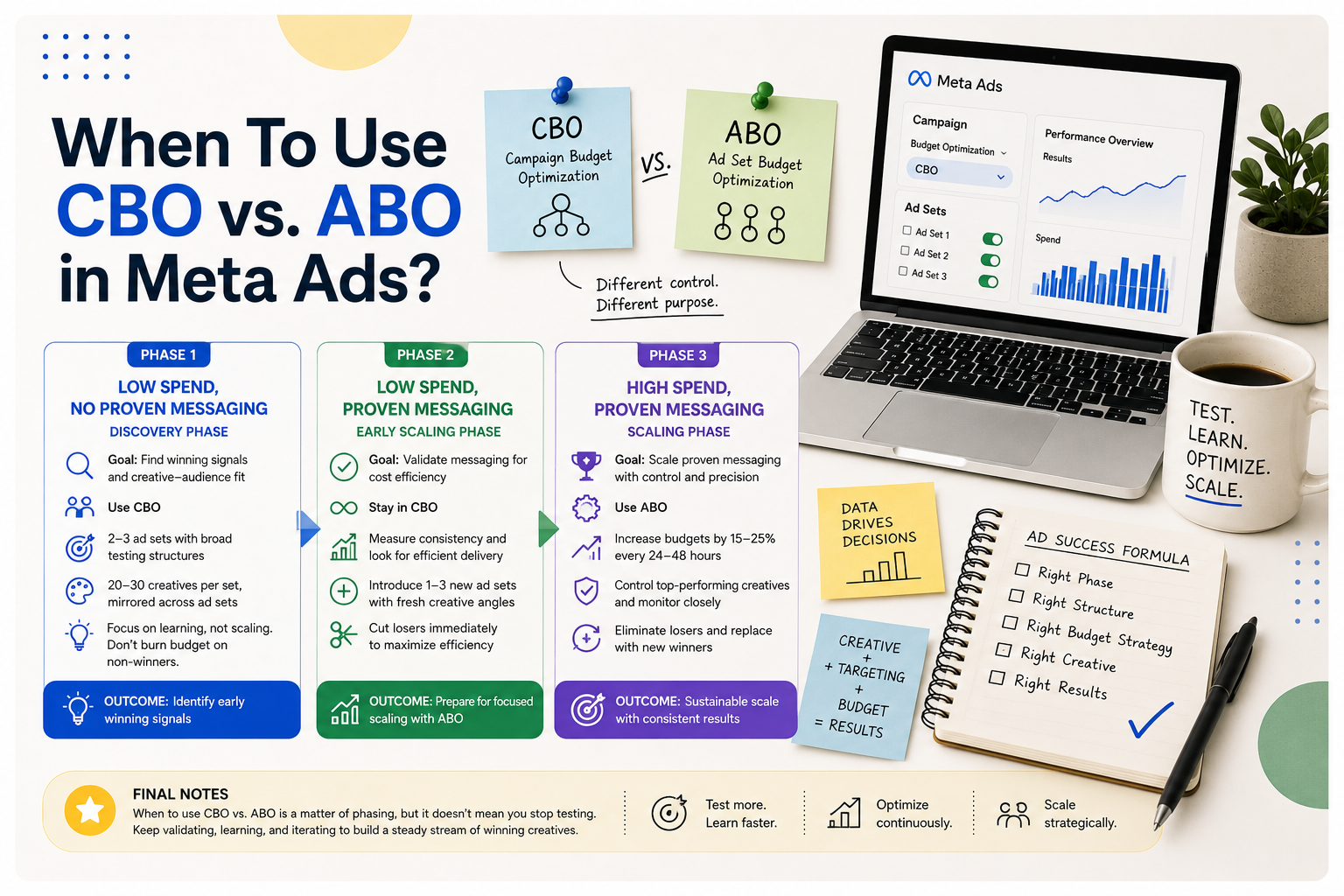
At a basic level, ABO (Ad Set Budget Optimization) means you assign budget at the ad set level, giving you direct control over spend distribution. CBO (Campaign Budget Optimization) shifts that control to the campaign level, allowing Meta to allocate budget dynamically across ad sets based on performance.
But, knowing when to use CBO vs. ABO in Meta ads is determined by where you are and in what phase of performance you are in, not just in what kind of ads you are running at the moment.
Phase 1: Low Spend, No Proven Messaging
When you’re in a stage that you do not know yet what specific messaging works to deliver on results, and when you don’t have a winning messaging yet, you are in the discovery phase. This means that you are not ready to scale, and you will not be ready to spend more than 1,000 pesos per day on your ads.
At this phase, CBO works best. You will want to have 2 to 3 ad sets with broad testing structures. Set up interest combinations, and broad audience parameters, and run 20 to 30 creates per set, but mirrored across all ad sets to isolate creative performance.
What you want to do at this stage is to find winning signals, or iterations from your creatives that match the different targeting stacks you have in your ad sets. You will want to find out which creative elements work in your individual assets vs. which ad sets they are winning in, without spending too much that you’re burning your budgets on non-winning assets.
Phase 2: Low Spend, Proven Messaging for Early Scaling
This is the phase where you’ve identified a piece of your messaging that works, but you wish to validate it further. So, you need to stay in CBO, but you’re now measuring not for discovery but cost efficiency. You’re looking for consistency in your early proven messaging to see if these will survive longer runtimes.
You will also now begin to introduce 1-3 new ad sets with fresh creative angles, learning from the early proven messaging to validate your findings. Continue to cut out losers immediately to maximize cost efficiency. You’re now preparing your ad campaigns to move towards more focused, isolated spending in an ABO configuration.
Phase 3: High Spend, Proven Messaging
This is where you want to be, in the long term. This is the phase where you have a proven and validated messaging, even after introducing new creative variants via new ad sets, and your performance still remains within a consistent margin. The goal here is repetition, and volume. You want to increase your budgets, but sparingly, as the ideal scaling methodology would be to increase to your ideal budget about 15% to 25% every 24 to 48 hours. This also gradually increase your ad spend alongside an improvement in your performance. This is ideal compared to increasing your budgets outright because the latter forces Meta to look for audiences beyond your validated ad sets, reducing your cost efficiency and increasing your costs per result.
Be aggressive, but cautious, in your scaling. You will also want to control the creatives that continue to perform, and monitor their performance. Just because they passed your validation does not mean that these creatives will not be subject to sudden algorithm changes and in their performance. Continue eliminating losers and replacing them with winners from the ad sets still undergoing validation.
Final Notes
When to use CBO vs. ABO is a matter of phasing, but it doesn’t mean that you stop validating non-winning ad creatives and learning from them. Continue identifying winning creative elements as signals to create creative variants, and identify winning ads to ensure you have a steady stream of validated assets.

James Michael Chiong is a digital marketing strategist and consultant who helps small and medium businesses in the Philippines grow through SEO, Meta Ads, Google Ads, and data-driven marketing strategy. With 10+ years of experience across agencies, in-house, and consulting roles, James has led digital campaigns for brands in real estate, publishing, education, BPO, retail, and professional services.
He previously served as Digital Director and Director for Digital Strategies at TeamAsia — an award-winning Integrated Marketing Experience agency — where he spearheaded the formation of TeamAsia DigiCreatives, a merged Digital, Creatives, and Technology unit delivering AI-assisted SEO, voice-enabled search, and end-to-end e-commerce marketing solutions.
James has been featured as a social media marketing expert on ABS-CBN News (My Puhunan: Kaya Mo!, March 2025), where he shared practical digital strategies for Filipino MSMEs. He has also been quoted in adobo Magazine in relation to digital transformation in the marketing industry, and has appeared as a guest on TeamAsia’s B2B: Breakfast to Business podcast on Spotify — covering AI in marketing and digital strategy during the pandemic era.
He co-authored multiple thought leadership pieces published on TeamAsia’s platform, including articles on social media authenticity, integrated digital marketing, and the intersection of creativity and technology. He was also recognized as part of TeamAsia’s new management leadership on the agency’s 32nd anniversary in 2024.
James holds certifications in Google Analytics and HubSpot Inbound Marketing, and has served as a Marketing Professor at Lyceum of the Philippines – Cavite. He is based in Bacoor, Cavite, Philippines, and writes about SEO, AI in marketing, and digital strategy on JC Digital.
As Seen In: ABS-CBN News | adobo Magazine | TeamAsia B2B Podcast on AI (Spotify)





One Comment