
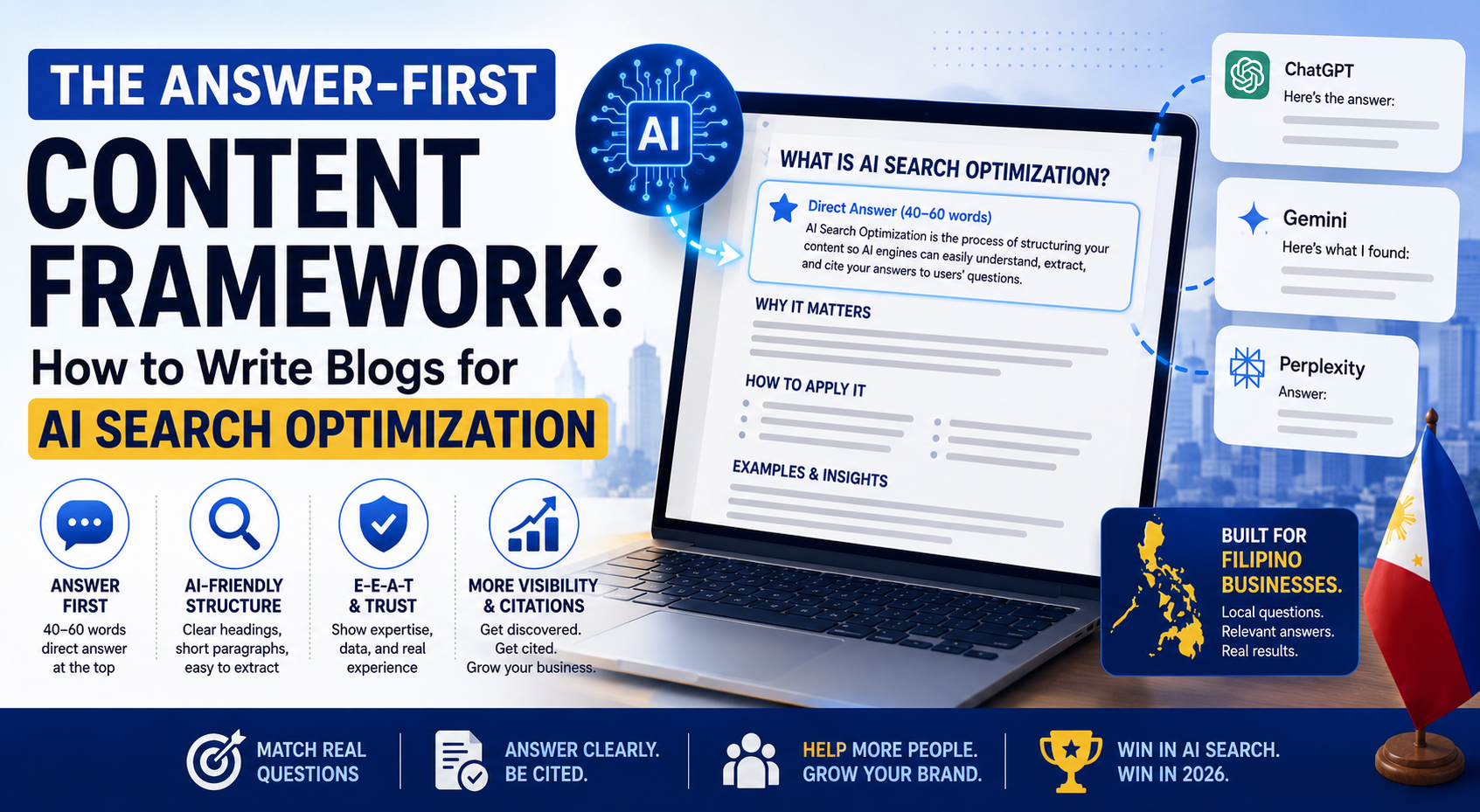
The Answer-First Content Framework: How to Write Blogs for AI Search Optimization
An answer-first content structure places a direct 40–60 word response to the main question at the very top of your page, before any background or context. This format allows AI engines like Gemini, ChatGPT, and Perplexity to extract your answer cleanly and attribute it to your site.
In my experience with content marketing and SEO, I thought before that it was just a matter of time before we moved towards content structures that simplified blogs further and further. What I wasn’t able to anticipate was that we were going to have to optimize them more for machines, if we are counting on LLM crawlers and bots to index and cite our content in AI-powered search.
But then again, content is ultimately made to be read by humans. It’s just that we need to get through the hurdle of getting indexed by bots and crawlers properly before humans could find our content, at least organically through search. Thus, ranking signals have become less of a visible list of results, but more of whether you made it in the contextualized AI-powered answer or not.
Why The Answer-First Content Structure Is Now a Ranking Signal for AI?
Most business owners assume that writing good content is enough to get found online, and a few years ago this was true in some ways. For the most part, what you needed to do was to stay true with your brand and consistently publish content and Google will pick up on your topical authority to rank you higher in search results.
In 2026, that assumption is only now partially correct. AI search engines, including Google’s AI-powered search and platforms such as ChatGPT and Perplexity, do not read your content the way a human does. They scan for structure, extract parts from your article where they could be appropriate responses to certain topics it already knows people already ask about, and synthesize responses from sources that make their job easier.
Thus, the answer-first content structure has started to become favored by LLMs because AI systems need to be able to find the best answers faster, in order to have a chance to increase your citations. If your content is not organized for machine extraction, it will be passed over because the format is unreadable to AI systems, regardless of the quality of your content.
How to Apply AI Search Optimization for Your Blog Post?
The difference between a traditional blog post and an AI-optimized one is not about word count or creativity. It is about information architecture, and the answer-first content structure emphasizes how quickly and cleanly the most important answer surfaces within your content.
| Blog Element | In a Traditional Blog, You Have a | But in an AI-Search Optimization-Ready Blog |
| Opening or the First Paragraph | Hook or anecdote | Direct answer (40–60 words) |
| H2 Headings or Sub Paragraphs | Creative or descriptive titles | Question-based phrases matching real queries |
| Content Paragraphs | 5 to 8 sentences per block | 2 to 3 sentences ideally, with one idea per paragraph |
| Placement of Data Proof | Buried mid-paragraph or toward the end | First sentence of each paragraph |
| FAQ section | Optional, placed in footer | Structured FAQ block with JSON-LD schema |
Each section of the blog should become a standalone answer, considering how each H2 is structured as a question, you should be able to imagine each part as being cited as an answer to the question being asked.
It should not just make sense for AI systems, but your content should ultimately provide enough context and information that it actually answers the question for an actual human need, not just to satisfy the algorithm. Remember that all of the ways SEOs have gamed the system have become penalized at some point, and doing so now will result to penalty scores and reduction of citations it not now then in the future.
How Can You Rewrite Your Blogs for the Answer-First Content Structure?
I have been writing content here in this website on and off for the past 5 years. While I’ve not been consistent for the most part, there are valuable gems in my content repertoire that has ranked for Google’s Search results in the past.
While the content you may have written for your website are older and no longer followers the Answer-First Content structure, you do not need to delete and in fact, you can actually restructure and rewrite what you already have. Your blogs may contain valuable insights that are simply encased under traditional blog formatting and structuring patterns that AI engines cannot efficiently parse.
- Audit your existing H2 headings. Replace your existing descriptive headings with question-based equivalents. Question-based H2 headings match the conversational queries that AI engines receive, increasing the probability that your section gets extracted as a relevant answer.
- Compress your paragraphs. Doing AI Search Optimization now requires shorter, but more packed, sentences. Take any paragraph longer than 4 sentences and split it into two. The resulting paragraphs should have a cohesive idea, which could stand alone as an answer to a question on its own, but at the same time continues to build onto the greater topic of the blog to ensure topical authority over the general query you are trying to answer.
- Front-load your data. If a paragraph contains a statistic, a specific example, or a named source, move it to the first sentence. AI engines are constantly looking for credibility and trust signals and proof points buried under your paragraphs does not make a good case for why your paragraph needs to be cited for the question you are trying to answer.
- Add a direct answer at the top of each H2 section. Before elaborating on any point, write one to two sentences that directly answer the implied question of that heading. Think of it as a mini-summary that AI can lift without reading the full section.
- Build a structured FAQ block at the bottom of every post. FAQs are among the highest-performing formats for AI extraction because they mirror the exact question-answer format that AI engines use to synthesize responses. Pair this with FAQPage JSON-LD schema, and your content becomes significantly more citable across multiple AI platforms.
How to Measure Your Success in AI Search Optimization?
Not all of the techniques done to adhere to the growing discipline of Answer Engine Optimization are foolproof. In fact, there may still be other factors in play, such as domain authority and URL rating metrics, that determine whether your content will be cited as an answer by AI engines.
The challenge is that AI citation metrics are not yet consolidated in a single dashboard the way traditional SEO metrics are in Google Search Console or Bing Webmaster Tools. Thus, there are a lot of bridging different sources and analyzing different metrics to see whether you are successful.
Start with manual citation testing. Open ChatGPT, Perplexity, and Google’s AI Overviews and enter the primary question your blog post is designed to answer. Note whether your site appears as a cited source and how the answer is worded relative to your content. Do this immediately after publishing a restructured post, and repeat every 30 days to track progress.
While this is not yet available to all users, there are features in Google Search Console for AI Overviews impressions under the Performance reports. Knowing exactly how many overviews your content has been cited on is a signal that your Answer-First Content structure worked. If you are also getting featured snippet appearances, look at this as a signal that your featured content is also structurally positioned to earn AI citations as they adhere to similar formatting and structuring rules.
Answer-First Content – Frequently-Asked Questions
What is answer-first content? Answer-first content is a writing framework where the direct response to a page’s primary question appears within the first 40–60 words, before background context, introductions, or elaboration. It is the format AI search engines are specifically engineered to extract and cite as authoritative answers.
How short should paragraphs be for AI search? Paragraphs optimized for AI extraction should be no longer than 80 words and should contain only one idea each. The opening sentence must state the core answer or claim directly. Supporting details follow in one to two additional sentences. Longer paragraphs reduce the probability that an AI system will extract and cite the passage.
Does schema markup directly improve Google rankings? Schema markup does not directly increase your traditional keyword rankings, but it improves how search engines and AI systems interpret and surface your content. FAQPage schema can trigger rich results in Google Search, while Article schema strengthens E-E-A-T signals. Together, these increase the likelihood of AI citations and featured snippet appearances, which drive visibility even in zero-click search environments.

James Michael Chiong is a digital marketing strategist and consultant who helps small and medium businesses in the Philippines grow through SEO, Meta Ads, Google Ads, and data-driven marketing strategy. With 10+ years of experience across agencies, in-house, and consulting roles, James has led digital campaigns for brands in real estate, publishing, education, BPO, retail, and professional services.
He previously served as Digital Director and Director for Digital Strategies at TeamAsia — an award-winning Integrated Marketing Experience agency — where he spearheaded the formation of TeamAsia DigiCreatives, a merged Digital, Creatives, and Technology unit delivering AI-assisted SEO, voice-enabled search, and end-to-end e-commerce marketing solutions.
James has been featured as a social media marketing expert on ABS-CBN News (My Puhunan: Kaya Mo!, March 2025), where he shared practical digital strategies for Filipino MSMEs. He has also been quoted in adobo Magazine in relation to digital transformation in the marketing industry, and has appeared as a guest on TeamAsia’s B2B: Breakfast to Business podcast on Spotify — covering AI in marketing and digital strategy during the pandemic era.
He co-authored multiple thought leadership pieces published on TeamAsia’s platform, including articles on social media authenticity, integrated digital marketing, and the intersection of creativity and technology. He was also recognized as part of TeamAsia’s new management leadership on the agency’s 32nd anniversary in 2024.
James holds certifications in Google Analytics and HubSpot Inbound Marketing, and has served as a Marketing Professor at Lyceum of the Philippines – Cavite. He is based in Bacoor, Cavite, Philippines, and writes about SEO, AI in marketing, and digital strategy on JC Digital.
As Seen In: ABS-CBN News | adobo Magazine | TeamAsia B2B Podcast on AI (Spotify)


2 Comments